DC SREC income: what it is, what it pays, and why it's declining
If a solar company is pitching you a loan and showing you SREC income as a reason to say yes — read this first. DC SRECs are real income, but the number they're showing you today is not the number you'll be earning in year 10 or year 15. And in 2026, DC SRECs also proved to be unstable. Here's what you need to know, whether you're thinking about buying or going no-cost.
A note from Indre: I work with DC homeowners on both purchased and no-cost solar. This article is here to inform you, not to sell you on one option. You make the call.
Don't Rely on SREC Income
SREC decline doesn't mean solar isn't worth it. See your real savings estimate based on Pepco bill reduction.
What is an SREC?
SREC stands for Solar Renewable Energy Certificate. Every time your solar system generates one megawatt-hour (1,000 kWh) of electricity, it earns one SREC. That certificate can then be sold to electric utility companies in DC who are required by law to source a certain percentage of their electricity from solar energy.
If they don't meet that requirement, they pay a penalty called the Solar Alternative Compliance Payment, or SACP. The SACP effectively sets a ceiling on what SRECs can be worth — utilities will only buy SRECs up to the price of the penalty they're avoiding.
In plain English: your solar panels generate clean energy certificates that DC utilities are legally required to buy. As of November 2026 those certificates trade around $375–385 each on the exchange — though after broker fees homeowners net a bit less, and long-term contracts pay less (Sol Systems' 2-year fixed contract pays $300). A typical 10kW DC system generates roughly 11 SRECs per year — about $4,000 a year at today's prices.
Why DC has one of the strongest SREC markets in the country
Washington DC has unusually strict renewable energy requirements. The District has committed to 100% renewable energy by 2032, with a specific solar carve-out that requires an increasing percentage of electricity to come from solar specifically. Because DC is a dense urban area with limited roof space and challenging infrastructure, solar supply has consistently fallen short of these ambitious targets.
That gap between what's required and what's actually installed has kept DC SREC prices far above other states. While SREC prices in Maryland or New Jersey may trade at $20 to $40 per credit, DC SRECs have consistently stayed in the hundreds of dollars — making DC one of the most lucrative solar markets in the entire country for system owners.
The SREC decline curve — what the data shows
Here is the part most solar loan salespeople skip entirely: DC SREC prices are on a structured, legislated downward path. The SACP — the ceiling that determines maximum SREC value — decreases on a fixed schedule set by DC law. As that ceiling drops, so does the maximum value of your SRECs.
At the same time, more solar is being installed across DC every year, gradually closing the supply gap that has kept prices high. More supply plus a lower ceiling equals lower prices over time. This is not speculation — it is baked into DC's renewable energy legislation.
Until 2026, prices held fairly steady around $350–375. 2026 changed that — prices swung by about $57 in six months (see below), and the long-term ceiling is still scheduled to fall. These projections are based on the DC SACP schedule and current market supply trends. They represent a gradual decline — not a crash — but the direction is clear and consistent. By the time a 20-year solar loan reaches its halfway point, SREC income will likely be roughly half of what it is today.
2026: the year DC SREC prices stopped being predictable
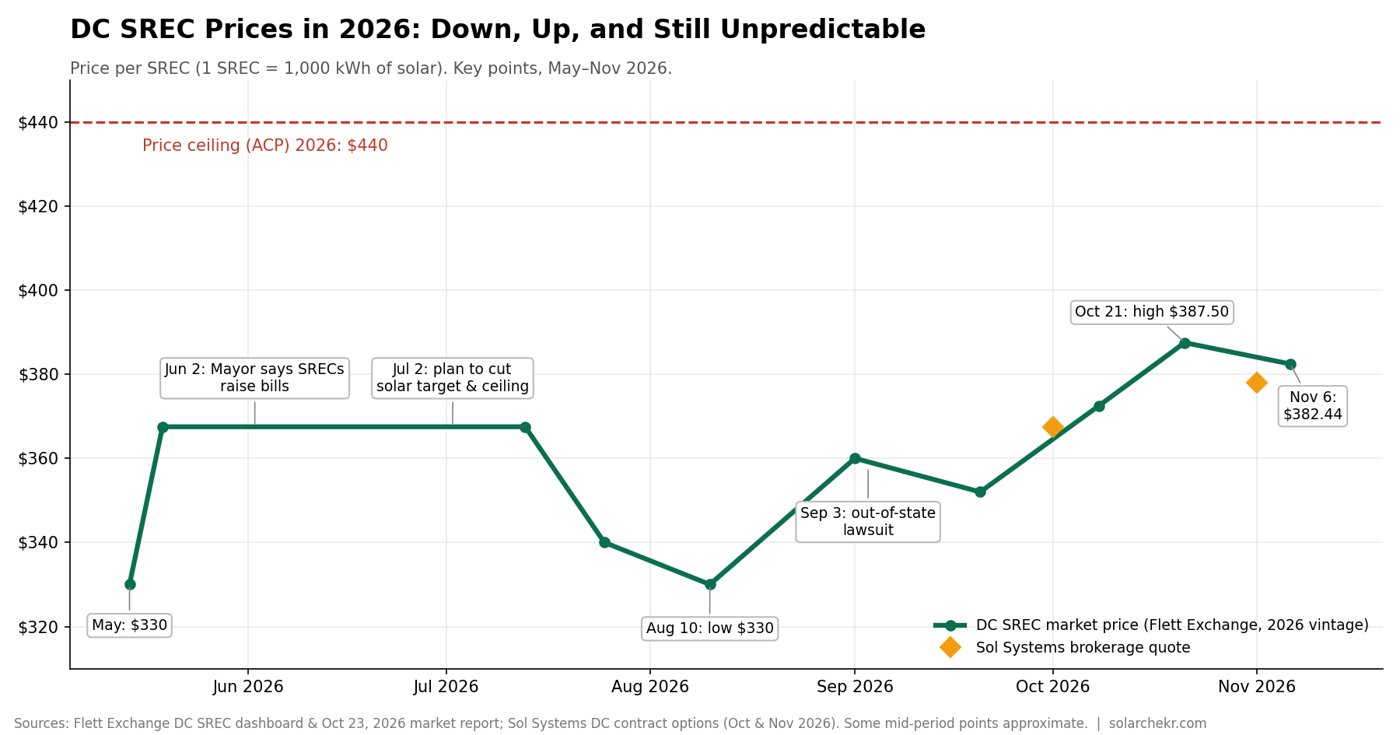
If you were told DC SRECs are "stable income," look at 2026:
- May: about $330 per SREC
- June–July: up to about $367.50
- August 10: back down to $330 — the low of the year
- October 21: $387.50 — the high of the year
- November 6: about $382
That's a swing of roughly 17% in six months. Nothing about the solar panels changed. What changed was DC politics.
What moved the price
- June 2: Mayor Bowser told the DC Council that DC SRECs are the most expensive in the country and will add about $40 a month to bills by 2029 if nothing changes.
- July 2: The Mayor's Energy Affordability Plan proposed cutting the local solar target from 15% to 10%, pushing back the deadlines, and lowering the SREC price ceiling. Prices dropped. (More on this in DC wants to cut solar credits.)
- September 3: A West Virginia lawsuit over out-of-state credits rattled SREC markets in DC, Pennsylvania and New Jersey.
- October: The FY27 budget passed with no change to DC's solar law — and prices bounced back.
What's next
The fight isn't over. The FY2028 budget debate starts next spring, and DC faces an estimated $680 million budget gap. DC also now has more certified solar than the law requires — and more supply usually means lower prices. Flett Exchange, one of the main SREC brokers, expects more ups and downs during next year's budget hearings.
The ceiling keeps dropping no matter what. The most an SREC can be worth (the ACP) is $440 in 2026. It drops $20 every year: $420 in 2027, $400 in 2028, and $300 by 2033.
Want to follow the market yourself? Flett Exchange posts DC SREC price updates on their blog and in their Reddit community, r/FlettExchange.
How this affects solar loan math
This is where things get important. When a solar company shows you the financial case for a loan, they typically use today's SREC price to calculate your "income" from the system. The pitch looks like this: your loan payment is $170/month, but your SREC income is $339/month — so solar is actually making you money.
That math is accurate in year 1. It becomes increasingly misleading as the years go on.
By year 10, your loan payment is still $170/month — fixed for the life of the loan. But your SREC income has dropped to roughly $170-$190/month as prices decline. You're barely breaking even. By year 15, you may be paying more out of pocket every month than your SRECs earn. The solar company showed you year 1. They didn't show you year 10 or year 15.
This is not a niche concern or a worst-case scenario. It is the predictable, legislated trajectory of the DC SREC market. Any solar professional who presents SREC income without disclosing this decline curve is not giving you complete information.
What this means for you
I'm not here to push you toward one option. I can set you up either way — buying your system or no-cost solar. My job is to give you the real numbers so you can pick what fits your home and your budget.
If you buy your system
- Cash, or a short no-interest loan (I can connect you with a lender that offers one): you keep the SREC income and pay no interest. This is the option where buying makes the most sense.
- A long-term loan is different. Unless the interest rate is very low, a big part of what you pay goes to the bank — not to your savings. Add the SREC ups and downs from 2026, and the loan can cost more than it saves.
- Either way, the SREC risk is yours. Prices dropped about 15% in a few weeks this year, and the ceiling falls $20 every year.
See the real monthly payments side by side: Free Solar, Loan, or Cash in DC: The Honest Comparison →
If you choose no-cost solar
You don't get the SREC income — but you don't carry the SREC risk either. You get a lower Pepco bill whatever the market does. How no-cost solar in DC works →
Neither one is right for everyone. It depends on your roof, how long you plan to stay in your home, your budget, and how much risk you're comfortable with. If you want, I'll run both options side by side for your address — free, no pressure.
What to ask if you're being sold a solar loan
If a solar consultant is presenting a loan using SREC income as part of the financial case, ask these questions directly:
What will SREC prices be in year 5, year 10, and year 15? Can you show me the projected income at those prices, not just today's rate? What is my net monthly cost in year 10 if SREC prices drop to $200 per credit? What is the total amount I repay over the life of this loan including all fees?
A consultant who answers these questions clearly and honestly is someone worth working with. A consultant who deflects, minimizes, or says "SREC prices will stay strong" without evidence is not giving you the full picture.
If your solar consultant is not telling you about SREC decline — they are either uninformed or they are choosing not to disclose it. Either way, it's a reason to pause and get a second opinion before signing anything.
Sources: Flett Exchange DC SREC dashboard and October 23, 2026 market report; Sol Systems DC SREC contract options (Oct–Nov 2026); DC PSC RPS reports. Prices change daily. Not financial advice.
Ready to see your solar potential?
Get your free personalized solar analysis for your DC home. No obligation, no pressure.
Get Your Free Quote →Buy or no-cost — see both for your home
I'll run the numbers side by side for your address. No pressure, you decide.
Book my free consultation →✓ Check if your home qualifies — takes 30 seconds
Buy or no-cost — I'll show you both options for your address.
No credit check · No obligation · Most DC homeowners qualify